Motto

The Whole Picture is Nothing But a Compilation of Details.


Saturday, January 29, 2022

Runners: a Different Breed

Runners come in all ages, shapes and sizes: tall,  short,  young,  old,  heavy-set, skinny. It is one of the easiest and most affordable forms of exercise for men and women to take up: All you need is a pair of shoes (it can be argued you don't even need that) and a little bit of motivation. 

Some people start running as young children; others start much later in life. Some race marathons;  others jog on the beach on Sunday mornings.  Some run fast;  others are slower. 

I know people who dislike running, but love to finish; others are the exact opposite: they love running and dislike when it ends. For me, running is the best way for me to meditate,  to turn off the constant chatter of daily life. 

The majority of us have a reason why we start to run: someone wants to lose a few pounds, someone else signs up for a charity race with friends or family, others are thrown on the track in high school and told to run. 

So motivation, age, gender, shape or size is not what ties us together, what makes us “runners”: In fact, the only thing we have in common is that we all put one foot in front of another.


Speed Work (2014)

Kenyan distance runner Kip Lagat once said when asked why his country produces so many great runners “It’s the road signs, 'Beware of Lions'." 

Every competitive runner tries to improve his or her time, to “run a better split” which in layman’s terms translates to run a shorter time over a pre-determined distance. In the U.S. we measure minutes/mile - most of the rest of the world measures in kilometers.  Regardless of the measurement used, the idea is the same: you try to improve your own time, or beat the competition across the finish line. 

I was never that serious a runner - I actually sort of fell into it when a friend needed a running partner for a Valentine’s Day race in Bradford. I was 30 years old.  

But working seventy plus hours per week, leaving little time to switch off, running quickly became my form of meditation, and when life threw me lemons, the distance increased from six kilometers to 13.1 miles. I stopped running with music, and instead let the pitter patter of my feet transcend me to a peaceful state of mind where I thought of nothing at all, yet somehow, I gained a lot of clarity. I ran my first half marathon in 2002. 

Twelve years of running meditation ensued. It was, as a fellow runner put it:  “it was not about the time I ran; it was about the time I had running”. I read somewhere that 80% of runners have sustained some form of injury in their “career” of running. I was no exception. After a stress fracture and knee surgery (unrelated to running) I finally got smarter and listened to my body: I started cross training and I entered my first triathlon in 2012 (also somewhat by chance, and a  “Why not?” attitude). 

Earlier this year I relocated for work, and joined the local triathlon team, primarily for social reasons. It’s not easy moving to a new town by yourself. Especially not when you have already put in your years socializing after work with co-workers over a bunch of drinks. 

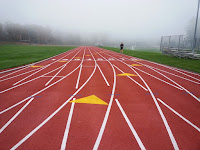
Birds chirping, I jogged down to the track early one morning for my first track workout. My first ever track workout. I saw a small group of women come around the cinder track, one turning her head and blowing hard to clear her nose, snot rockets flying everywhere. Triathletes. It takes one to know one.  

After a quick introduction to the track, related etiquette and an explanation of the prescribed workout (who knew one lap is 800 meters!?), we completed the set, doing the best we could, egging each other on, pushing ourselves to go faster, to do better.

The summer went by, our track workouts occasionally broken up by a trail run. The other women had fancy watches telling them the exact pace they ran- I just did the best I could, but noticed I was getting stronger and faster, chasing the heels of the two fastest runners in the group.

Proof is in the pudding, and the improvement took me by surprise in my favorite race: the Wallis Sands Triathlon in Rye Beach, NH: After swimming ⅓ of a mile, and cycling 14.5 miles I ran 5km with an average pace of 7.08 minutes/mile - well over a minute faster/mile compared to the same race two years prior.

So if you are looking to get faster, move to Kenya or go to the track. 


Friday, May 10, 2019

Ode to my Other Home Town

You can take a Swede out of Sweden but you can't take Sweden out of a Swede.

Tuesday, October 24, 2017

Bulgaria: First Impressions


Bulgaria: A Time Capsule:
Bulgaria is a very curious country, and leaving the capital, Sofia for my next destination I felt a bit like I just left an experiment in a time travel capsule:


Land of Cross Roads and Contrasts:
Bulgaria’s geographic location has always been one to desire and as a result, newly discovered and escavated, well preserved architecture of the Roman Empire rubs elbows with Communist cement blocks and modern homes. Mosques, stand next to, or in some cases, on top of orthodox Russian churches. "Klek" (knee) shops, a remnant of a socialist era where the shopping outlet is at knee level are nestled between trendy restaurants and coffee shops.


It is poor in many places, but not like what I experienced in Nicaragua or parts of the Caribbean or Venezuela.
It is beyond rich in ancient history, with documented history dating back to the Stone Age, but not like the crowded and overtraveled Rome.
It has strong culture but it's genuine and immersive versus popularized to be more palatable to the outsider.
The food is organic, not to be trendy or healthy but because they know no alternative.
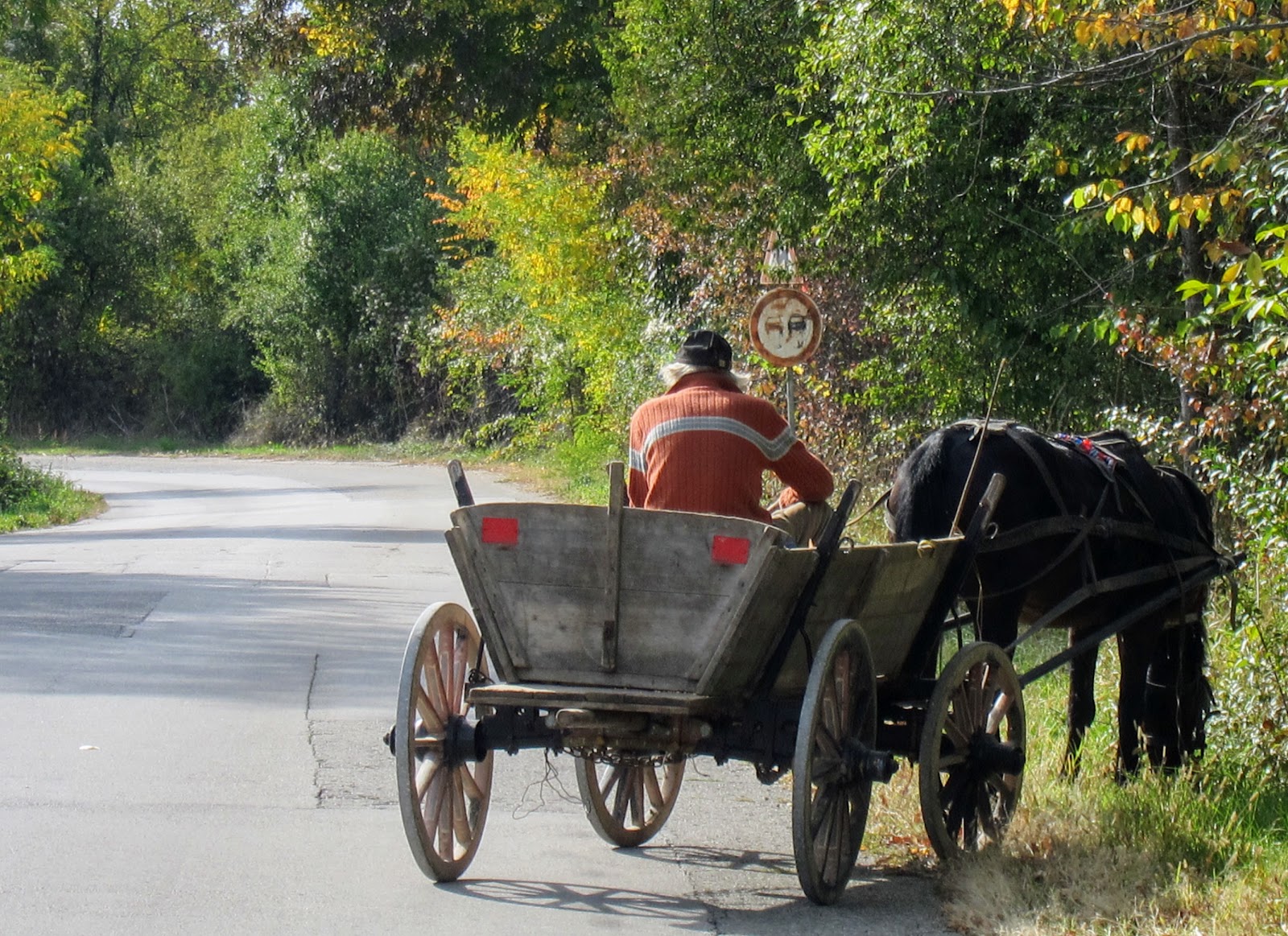
BMWs and Mercedes mingle easily with horse carts and vintage Ladas; sometimes with a goat in the backseat. No matter the wheels or the company they keep, most drivers are holding on to a cellphone and a cigarette.


Deserted Villages and Towns:
As you drive through the countryside, it's impossible to not notice the many deserted villages, the empty school, and houses with overgrown gardens and caved in roofs. People here began migrating, first to the cities during the years of communism: 1946-1989, then with Bulgaria joining the EU in 2007, to other countries in hope of better opportunities and lives.


However, the tide is turning, and several villages are now experiencing a rebirth, as younger people re-evaluate their lives and values and return to, and resettle in their home town.

The People:
Bulgarians are friendly but generally don't smile until the end of a conversation. They are funny - a slapstick kind of funny. And they are, for the most part, helpful to those who don't speak their very unique language- just remember to not be deterred by point number one above.


There are still smokers live in Bulgaria.
Lots of them, and they have converted seasonal outdoor cafés to year round smoking sections under the logic that they are outdoors.


Then there are the Romas: a complex topic to say the least, and I claim to be no expert but this is what I learned so far: The Romas are a nomadic tribe with their own language and customs, yet within the borders of Bulgaria they are considered Bulgarian, effectively living an in-between existence of being a part of society and being nomads, which has led to ripe conflicts not only in Bulgaria but all over Europe. Modern times have forced them to adjust, and as an example, today, some 70,000 Romas have settled outside of Sofia, living in terrible conditions.


Food:
Bulgarians like to eat, and I don't blame them: The food here is characterized by the freshness of the ingredients, first and foremost: everything is fresh, with nothing - in the true sense of the world - is added for texture, color, taste or otherwise twisted ways of making foods more “attractive” for human consumption. The result? Flavors like no others: roasted cashew nuts where you taste the smoky, salty flavor without there being any added salt; melon gelato that tastes like fresh, organic melon. Only better. Desserts that don't taste like chemicals, and shockingly (or maybe not) don't have a habit of glueing themselves to your waste line if you as much as look at them…
Fresh, delicious yoghurt, gelato and cheese is everywhere, and seemingly in a mocking way, to point out the obvious, cheese is called processed if it's anything but fresh cheese.

Finances: 
As the icing on the cake, Bulgaria is an incredibly economical destination, so splurging on delicacies and a five star hotel is totally possible, without putting as much as a pimple sized mark in your wallet.


Looking ahead:
Without a doubt, over the coming years, private and public investments in tourism will continue to grow - beyond the Black Sea, currently popular with the European drinking crowd:
Plovdiv, the 8th oldest city in the world is the 2019 European Capital of Culture; a new north-south highway currently under construction will expediate road travel to more remote parts of the country; and with more visitors and an increasingly strong global connection- Bulgaria will be the new European Destination within five years.


In closing, my final reflection:

if you seek the Real and Raw, and the road less travelled, go now. Or if that is beyond your comfort zone, wait for the new highway to be built.

Sunday, April 16, 2017

Spring is here: A little bird told me.

North of Boston, April 16, 2017

Around here we all expect several more weeks of unpredictable weather, and know that a hot day with temperatures in the 80s, like today is but an utter fluke and a tease for the warmer weather we so long for after several months of winter.

Brave flowers have stuck their colorful noses out but may be covered in frost tomorrow.

We have broken in to the summer clothes but won't yet pack away the winter coats, and the snow shovels may best be left out handy for another day or two.

But today I saw the first swallow of the season fight her way into the stiff breeze of Marblehead harbor, a sure symbol of spring.

The swallow is said to represent love, care and affection toward friends and family, and to carry a drowned sailor's soul to heaven. They also symbolize freedom and hope so I'm putting that shovel away tonight.

Friday, March 24, 2017

Spam

Someone seemingly hacked into my blog... don't open links.

Friday, January 15, 2016

Review: The Other Part of Massachusetts

It's time to move. Again. After nineteen months inland, like a sailor intoxicated by the songs of the sirens in old Greek Mythology I have been beckoned and lured back to the shores north of Boston again, my home for eighteen years before taking a job in Northampton in the western part of Massachusetts in December almost two years ago. 

Northampton and surrounding areas in "The Pioneer Valley" treated me well.  Here's my list of favorites, in no particular order:

The Bookmill, the Lady Killigrew Cafe and the adjacent Alvah Stone restaurant in Montague: located right on the rushing river this duo of restaurants and a terrific, funky, used bookstore with an extensive section for music have something for everyone, year-round. The dominating attraction and what permeates the atmosphere for all three is the sound of the river that sets the tone throughout, leaving no choice other than to take a deep breath and relax. The Alvah stone offers innovative cocktails and plated dinners; the Lady Killigrew Cafe is more informal, serves an excellent selection of beer and wine, and has the best curried chicken salad around. 
Tip: nitro milk stout, and chicken salad on a bed of locally sourced micro greens. 

The natural jacuzzi downstream from the Bookmill. Cleanest water and the strongest jets you'll ever experience! 

An afternoon in the Adirondack rocking chairs at the top of Mt. Skinner, watching the thunder storms roll through the valley. 

Swimming at the D.A.R. in Goshen, before or after the lifeguards' are at work.  The water is warm, clean and usually smooth as a mirror. 

Tucked away in the parking area down behind Main Street is the quiet, a bit more mature and plenty more European than any of its competitors in town: la  Fiorentina, the best spot for the best espresso and gelato in town. Restaurant Spoleto also gets their tiramisu from here, light and creamy. Need I say more?

Cross country skiing at the Northfield Mountain in Northfield. Although there is a nice loop in a field for skating and beginner classic skiers this is a mountain and expect nothing less. Hills! Hills! Hills! But what goes up will come down (my mantra challenging myself up the steepest hills) and you do. Exhilarating fast! Rentals available. 

Mapleline real milk in glass bottles. No cardboard. $2.50 deposit on the glass bottle and the milk from cows grazing in the next town over. Mooooo. Makes me happy. 

The Northampton Cycling Club. Seasonally from +/- May - October weather dependent. Great group of folks riding together weekly on country roads and through the hills. Varying levels. We may look intimidating but don't judge the cyclist by our Lycra.  

Thanks to all who made me feel welcome. Thankfully I'll be back regularly. 


-- 
Eva Mossberg
 
Phone: 978.836.9133
Skype: eva_mossberg
Blogs: Impressions: www.evamossberg.blogspot.com and 
My Other Space: http://evamossberg.wordpress.com/ 

Sunday, May 17, 2015

The Art of Eating

"One cannot think well, love well, sleep well, if one has not dined well." ~Virginia Woolf

On a recent business trip to Spain, Catalonia to be exact, it became painfully obvious, that living in America where "eight out of ten people eat at a fast food restaurant at least monthly, with almost half of them saying they eat fast food at least weekly" (http://www.gallup.com/poll/163868/fast-food-major-part-diet.aspx), I had forgotten what eating really is, even though I belong to the mere four percent who say we don't eat at fast food restaurants.

In Catalonia, eating is taken to a whole different level:


Breakfast. Desayuno is divided into two meals (just that is genius in and of itself!): Easing into the day, we start with café con leche and something, anything, to dunk in it: typically a croissant; plain or filled with chocolate. Late morning, breakfast part two consists of a simple sandwich of freshly baked bread, like a small baguette, with cheese and/or ham and cheese. Nothing revolutionary yet, right?

But lunch. Hold on! This is not the time to get disinterested...  So much more than what you are thinking... unless you are lucky enough to be able to relate. Lunch. Take the word in your mouth; roll it around a number of times; taste it. What do you taste?

This incredible meal is as important in Catalonia as it was for Catholics going to church in Italy every Sunday 100 years ago. Working though lunch, hunched over your desk is not an option. No, not even for you. It is a meal over which you connect with business partners and coworkers, family and friends. Starting around two o'clock, taking place over at least two hours, it entails a first course, a second course, dessert, inclusive of wine, water, ending with café. The most common is to order the menu of the day - a selection of three starters, three main courses and three desserts. Since this menu highlights the house specialties it is going to be freshest, and thus, will be my recommendation to you.

"La cena" e.g. dinner is another important meal (are we catching on yet to the fact that every meal is important?) but much more modest than lunch, and eaten late, usually after 9 pm. I am convinced it is slated so late in the day only so we can fit another meal into the day:  la merienda (snack). Or perhaps it has to do with the heat. But does it really matter when it gives you an excuse to have bread so fresh out of the oven that it is still warm, with chocolate on it? Or perhaps jamon iberico and fresh cheese is more to your liking?

Whatever suits your fancy, enjoy! Eating is sharing so much more than food. It pleases more senses than taste and fills more than just your stomach. Eating is an art. Eating is joyful, Eating is relaxing, Eating is a ritual. Eating is cultural.  Done right, it fills your soul!

¡Buen provecho!

Wednesday, June 4, 2014

'Tis the Season


Max Performance Season Opener May 11, 2014: Fantastic race, wonderful weather and a friendly, fun crowd, as always.

Glorious sunshine, and dry conditions with temperatures in the fifties, I couldn't have asked for anything more. The water was a "refreshing" fifty-three degrees so wet-suits were mandated by the race officials, which for a cold water enthusiast, was disappointing but thankfully took that decision out of my hands, saving me at least one agonizing battle with myself, trying to decide on just the right piece of equipment. Heeding to their warning of frigid water I did my warm-up in my full wet-suit and got hot, so I changed into my shortie (short legs and arms). Thrilled to feel the water on my skin after a long winter, I was happy as a clam at high tide for the five minutes I was in the wet but not so much when I got back out on the dry...  every muscle screamed so I made the decision to change back to the full wet-suit. Lucky for me that was not a timed transition. I finally squirmed my way into the skintight black neoprene just in time for the national anthem, and walked down to the start in an sea of black neoprene topped with white, pink, blue and green. You could feel the air quiver with the nervous energy generated by the field of athletes ready and eager to start the first portion of the race: the 1/4 mile swim.

It was the usual frenzy of kicking legs and swinging arms; a straight shot downstream past three buoys before heading to shore. A friend, upon seeing the video my friend shot said aptly "You look like a pack of sardines fighting blindly to get away from a shark."   I like to think I apply a bit more strategy to it than that, but having seen other heats, the image is certainly spot on. I'm quite certain it is good that we can't speak when fighting for our own path to the finish line.

The cycling course, which I'd scouted the weekend prior got changed and shortened last minute due to roadwork so I rode it blind, as did everyone else so the playing field was level in that respect. After that it comes down to bike and fitness levels which varies greatly in most races. I give a lot of credit to participants who push along on a hybrid or worse. I personally wouldn't be caught dead competing on one: Too much work, not enough results. Eager to get the best possible time in transition, I tried a new innovative way of mounting my bike, which instead of gaining precious seconds set me back approximately twenty-five seconds. Note to self: don't ever, ever try something new on race day, even if you practice a few times before the start and think you have it down pat...  Duh. I know better but tried anyway. Sometimes in life it seems we have to be reminded of why we do things a certain way.

After about ten miles of navigating a course full of potholes, sand and frost heaves, I went creaming down the steepest hill on the course, excited about the decline and a nice stretch of pavement when a gust got a hold of me and the bike and for an instant I had that feeling of "oh this is going to be ugly; at least I won't take anyone with me when I go down..."  With my heart in my throat but focused, I caught myself thinking lovingly of my older, heavier bike but also found myself grateful for the forced opportunity you only get in a race, hellbent to finish, to learn the limits of my new bike: No limits.

After putting the bike away and stepped into my running shoes, it was on to the final leg: a five kilometer run.

Running after cycling is always torture: Going from an average of 17-24 miles an hour where the scenery buzzes by in a blur to seven or eight miles an hour inevitably makes you feel like you are moving through quicksand. Add an uphill start, and you feel like you are standing still. However, is just a matter of pushing forward trying to catch the guy in front of you, one foot at a time, which I managed to do to the extent of a new PR of 7:50 splits on a moderately hilly course, sprinting across the finish in 8th place in my age group with plenty of juice left (would've placed 6th if I hadn't messed around during T2. Would've, could've, didn't...).

Made me think I should have worked harder, however as the first race of the season, and with three weeks of travel beginning the next day, my first priority was to not get injured: a goal I reached.

Wednesday, January 1, 2014

Living In the Sticks 101

I recently moved to the western part of Massachusetts. Today on my way home, I drove past my exit, INTERSTATE 91 (i.e. a BIG sign). Next possible turnaround? Thirty miles to the west, in the Berkshires. It was snowing out there.

Thank god I don't live in Idaho.

Wednesday, May 29, 2013

"The Perfect Job"

Salem Career Center. 7:30 am.

Sitting in a hallway on a dingy oriental carpet with twenty or so other unemployed citizens aged 30-50, waiting for the Career Center/ unemployment office to open. One young fellow has clearly mistaken the waiting area for his own living room, yawning audibly, stretched out, his gut spilling onto the floor. The rest of us are on our smart phones; some friendly, soft spoken chatter bounce off the tall ceilings. Most of us have been here before.
Getting here at least one hour before they open at 8:30 am is standard practice and a necessity if you have trouble with your claim. Clients are seen on a first come, first serve walk-in basis and the demand is high for the one, sole staff member who handles claims. Sixty people are seen daily over four time slots: 8:30-10:00 am, 10:00-11:30 am, 1:00-2:30, and 2:30-4:00 pm. Calling the Department of Unemployment Assistance is an alternative, albeit very ineffective: Yesterday I spent 45 minutes listening to classical music before getting through to a representative. He couldn't help, but instead gave me a different number to call to speak with my claims adjuster. With high hopes for a breakthrough in my fight against red tape, I dialed the number. They picked up on the second ring: "Mass General Hospital, Dr. Cohen's Office". SIGH. No option other than to call the help line back: I was on hold for another 45 minutes before being told by a different representative that "the adjuster would call me within eight to ten weeks, that names and numbers of adjusters are never given out. Until then, your claim is on hold."

This translates to no unemployment assistance until then.

You think being unemployed is "the perfect job"? Think again...

Thank god for savings and summer jobs.

Eva Mossberg
http://evamossberg.blogspot.com

Thursday, May 23, 2013

Lost in My Native Country

On the road again. Going for a quick jaunt to see the family in Sweden. Yawn. But this time my wish for a travel buddy has come true... a friend from St. Tropez is meeting me there.

Deviating from my usual British Airways flight, surrounded by Krauts (friendly stab at the Germans, originally derogatory term coined during WWII), I embark on Lufthansa's flight 423 bound for Stockholm, via Frankfurt. Upholding their reputation for being punctual and exact, everything is just so. We even depart prior to our scheduled time since everyone's on board and "vee vant to arrive Frankfurt on time". Beverage and food services are delivered efficiently, including alcoholic beverages which were eradicated from airline services long ago to help combat falling revenues and higher fuel costs. As a traditionalist, I embrace the welcome return of what once was, even though I personally abstain from drinking alcohol on flights.

Frankfurt Airport welcomes me with the smell of freshly baked bread and coffee: Bread is baked on site and there are automatic free coffee dispensers abound satisfying your need for a latte, macchiato, or espresso  - just follow the trail of people carrying little red cups and you'll find one of the many stations. Don't bother looking for the decaf option. Europeans are purists.

Kungstradgarden
Getting to and from Arlanda Airport couldn't be easier: comfortable bio fueled buses, equipped with safety belts which all passengers use, depart for the Stockholm city center every ten minutes. Tickets are sold at the visitor center inside the airport, online, in ticket machines outside and on board the bus. A one-way ticket costs me 99 SEK, approximately US $13.00, and I'm in the city 45 minutes later. Taxis cost between three and four times the amount, but should that be your preference, getting one won't be a problem. Taxis are licensed and accept credit cards. They will save you 15-20 minutes.

Guard at The Royal Castle 
Skansen


Pike Heads. Fjaderholmarna.

 Ignoring jet lag "a condition that is characterized by various psychological and physiological effects (as fatigue and irritability), occurs following long flight through several time zones, and probably results from disruption of circadian rhythms in the human body" (http://www.merriam-webster.com/dictionary/jet%20lag)  is not recommended, no matter how excited you might be. It will make you queasy, or worse, especially when coupled with jumping on a trampoline after dinner and drinks. (Hard to resist nieces and nephews.) Give your body a chance to adjust. 

Distances in Stockholm are deceptive. An avid runner, I set out to run the morning after arrival (again, reference above paragraph on jet lag) and cover the very outer limits of my childhood territory in thirty minutes. So I run another lap, dodging dainty deer munching tulips and hares with big floppy ears hopping down the middle of the road. Idyllic? Most certainly, yes.
Roof Top Tours

Riding the "tunnelbana" - the subway system is easy: all stations have maps, are well marked, and all subway lines are color coded and connect at T-centralen (there are one or two exceptions) and safe. I notice a mother leaving her Baby Bjorn stroller where it can easily be stolen, but the Swedish logic says "what would a drug addict take my stroller for?". And based on what I witnessed, they don't.

Roda Villan, Fjaderholmarna
Swedes speak English. Very well, and very happily as they are eager to practice their "internationalism" every chance they get, so even if you try to speak Swedish, or if they "somehow" detect that you are a foreigner before you open your mouth, they will be proactive and address you in English. Contrary to Paris, it is perfectly accepted to address someone in English; you don't even need to ask if they speak English. Because they do.

Water is everywhere.
My idea of exploring a new place is to first grab a coffee at a local cafe and see where the tourist are heading. I take note and go in the opposite direction... This is not what my friend had in mind: zig-zagging the city for three days, we visit the Royal Castle, several art galleries, Gamla Stan, Stureplan, Ostermalms Salu Hall, Photografiska Museet, SoFo, Globen, the Vasa Museum, Skansen, the Cherry Blossoms at Kungstradgarden, Djurgarden, and Fjaderholmarna. The must visit attractions are Fjaderholmarna, Skansen, Djurgarden, and the rooftop tour. Naturally, we also sample the local cuisine, an absolute must for any visit abroad, and in my opinion more important than any museum or statue. For me, the highlights are fresh, fried herring out of a food cart parked at Slussen, thin, Swedish pancakes with ice cream and chocolate sauce, a ham and cheese panini at Roda Villan Fjaderholmarna and not the least, the glass of wine enjoyed in the warm sun at Kajen, quay side on Strandvagen, overlooking the ferries and pleasure boats criss-cross the blue water.

Fjaderholmarna


Sunday, February 24, 2013

C.R.U.I.S.E: Epilogue

Feb. 23, 2013

Balboa Clipper update from crew member to me:

"we hit 11.5 knots on the clipper then the sheets for the jib jammed on the anchor on deck a mess so we dropped the mainsail and Cap lost the bitter end and I got hit by the boom and hung on for dear life! fixed that mess too...did I mention the mizzen mast blew thru the floor and I jammed Kellys steel bucket to keep it from punching the hull? ..on dry for awhile!"


C.R.U.I.S.E Part V: The Bitter End

http://evamossberg.blogspot.com/2013/02/cruise-part-iv-between-devil-and-deep.html

Cringing dinghy my companion
Howling winds my chorus
Wincing wood my lyrics
Tomorrow my hope

-Written by crew member at 4 am.

We are all eager to get to dry land, each of us with our own reason: To get parts so we can put the boat back together and sail on to Belize, to eat something other than rice and beans, to socialize, to experience the renowned Fantasy Fest (http://www.fantasyfest.com) where body paint is more prevalent than clothes, to get away from the damned boat that won't stop moving like a rocking horse... I have one more day left of vacation and, full up with adventure and close calls, there is nothing I want more than to spend it somewhere, anywhere, away from this boat.

We part ways at the dock - in typical fashion, the crew goes one way, the captain another. Us crew members fall into the nearest restaurant, relieved to be on "the hard". The TV broadcasts continuous updates on Tropical Storm Sandy saying it could be "a rare event" and we discuss returning to the boat versus not returning to the boat. When the waitress asks what we'd like to drink we laugh out loud and in unison order three dark and stormys, a lovely concoction of spiced dark rum, ginger beer and lime.

Further decimation happens among the crew after breakfast. I'm in the contingency of two who go to explore Fantasy Fest. Originally an initiative undertaken to boost tourism to the Florida keys in the slower months, Fantasy Fest week has taken on a life of it's own and now produces the most revenue of any week during the year. It's a show, a carnival with festive floats, costumes, no shame, a whole lot of body paint and even more rum.


We circle back to the dock between rounds of rum punch and at long last we intercept the captain, soaking wet, dinghy in tow. Soon, a crowd gathers, soaked boat cushions, a cooler, frozen chicken thighs, a few apples, and life jackets are offloaded onto the dock. We can't help but laugh at it all. His attempt of returning to the Balboa Clipper with one of the crew members, groceries and a new steering cable had failed, in the true sense of the word: Going straight into the weather, one wave too many had come over the bow and claimed the rights to the dinghy directly in front of the coast guard station. The rescue was swift but far from painless to the ego. When the TV crew on board the coastguard cutter asked for permission to film, the answer was reportedly "short and negative".

I now really regret not having taken my backpack off the boat and since none of the other crew members have any intentions of setting foot on board that night, only I remain to go back out with the captain. Despite the inherent risk, my heart pounds with excitement. This is another Louis and Clark expedition! Oh the fine line between brave and stupid... Engine flushed out and reattached to the dinghy, we test the waters once more, with almost the same disastrous result as the first attempt. Bailing feverishly to keep up with the waves crashing over the dinghy, we joke about what to tell the coast guard if a second rescue is required...  "Um, yes sir. I found this lovely young lady ashore... I'm sure you understand..."  Luckily, no such scene is called for and as soon as we reach the Balboa Clipper (almost not soon enough) we quickly clutch the stanchions and haul ourselves out of the near sinking dinghy, bucking like a yearling under saddle for the first time. With an acrobatic balancing act and not just a little bit of luck we remove the engine, check the anchors, dry out soaked wallets and cellphones, secure what can be secured, and put our heads down for the night.I'm fully dressed, including life jacket. My passport and wallet are in a watertight bag in my zipped up pocket.

Against all odds, I sleep very restfully. Probably from sheer exhaustion. And the knowledge that I'm close to the end of this delivery. I have booked a ride in to shore in the morning with a shuttle service, will grab a taxi to the airport and once there with a boarding pass in hand, I will have a stiff drink and not worry about my safety for the first time since we left Fort Lauderdale.

Now I need a vacation.


Saturday, February 23, 2013

C.R.U.I.S.E. Part IV: Between the Devil and the Deep Blue Sea


http://evamossberg.blogspot.com/2012/12/cruise-part-iii-cut-and-run.html

Our boat is quickly transformed to a floating repair shop, brightly illuminated by deck lights. Not only is the steering cable off its track: The bowsprit is looser than it was when we cast off in Fort Lauderdale due to a rotted out heel, and there is a one inch play in the steel plate securing the mizzen mast.

Looks like we'll be here for awhile.

A surprising amount of tools are pulled out of the hold, one by one, like rabbits out of a magic hat; a mounting mess including hundreds of feet of anchor chain, a portable generator, a sawsall, spare pieces of wood, steel bars, caulk, glue, drill sets, socket sets, various hammers and mallets, bolts, nuts and screws of every size imaginable... In the wee hours of the morning, the moon, a creamy yellow big crescent of cheese sets in the big blue, and defeated by fate, we find a place to rest. I curl up in my sleeping bag under the dodger, worried about the prospect of our floating scrap metal yard being tossed around by the elements due to a dragging anchor with no available options of maneuvering. I wake up continuously.

Morning comes, and with energy levels and hope restored, the Balboa Clipper is pasted together with a mixture of ingenuity, steel plates, and marine caulk. I'd like to point out that, against all odds, the second most common problem on a boat, after crew, is not in need of repairs: the packing is tight and sounds like a happy donkey each time the handle is raised and lowered to flush. As a result, we begin to refer to the head as The Donkey. It didn't take long for "I'm going to hit the head" to become "I'm going to feed the donkey". Ah, life on board a boat...

We set sail, haul the anchor, and point the nose to the west, hoping to reach Key West before we have an altercation with the rapidly approaching, recently upgraded Tropical Storm Sandy. She brings us plenty of wind and a display of spectacular storm skies to our aft, but the skies above are blue and the winds on our backs. If I could only shake the constant, nagging feeling of "when?"

 "When" happens at sunset, just as we enter the channel to Key West, in close proximity to other boats and the hard (i.e. land) for the first time in sixteen hours. The emergency tiller, a two feet long steel shaft is installed and in 35-40 knot winds we enter the mooring field, its water boiling with whitecaps.

Another meal of rice and beans, anchors out and holding, wind howling through the rig. With no reliable steering, I'm happy that the Coast Guard Station is located eight hundred yards away.

We wouldn't need them until the next day.


Sunday, December 16, 2012

Season Opening in the White Mountains 2012


North Conway is a quiet little town about three hours north of Boston. Each summer its 2,400 residents are driven mad or out of town by the droves of tourists who flock here to camp on the shores of the Saco River, drift lazily in a canoe, shop the many outlet stores and bring their children to the crazy attractions they are sadly brought up to crave: Santa's village, Storyland, indoor water parks, and some nutty monkey-banana themed zipline place.

The Other Season attracts winter hikers, alpinists, climbers, and skiers. People who prefer short days, freezing temperatures and clear, crisp air with endless visibility to ferocious bugs, crowds and hazy humidity which forces you to process the thick, heavy air for oxygen, like plankton whales sieve water for food.

After six months of saltwater and triathlons, I was totally stoked to return to the White Mountains, the most rugged mountain range in New England for the start of the winter hiking season. Using both carrots and sticks I coerced a few people to bag Monroe (5,371'), Franklin (5,003') and Eisenhower (4,780'), a hike of approximately eight miles and a total elevation gain close to 4,000 feet. Pretty ambitious for a warm-up but I was as excited as a child waiting for Christmas morning. We would take the short but very steep Ammonoosuc Ravine Trail up to Lakes of the Clouds Hut, gaining approximately 2,800 feet in elevation in the first 3.1 miles and pay our respects along the way to Herbert J. Young who died here of exposure in 1928, before heading south on the Crawford Path, the oldest, continuously maintained, hiking path in America, originally built during the 1800′s and used as a horse trail, across the open ridgeline up and over Mt. Monroe and Mt. Franklin, continue south to the saddle between Franklin and Eisenhower before heading over its summit. From Eisenhower we would descend Edmands Path which, according to one trail description is "fairly steep, but gets you down fast". How? I wonder.

A friend had offered us to stay at her house, a treat instead of driving six hours in one day to hike for six hours which I'd normally do, and treated us upon arrival to an evening of story telling (read: local gossip) around the fire pit. Dressed like Michelin men, in down jackets, hats and mittens, we sat with new friends and crazy canines (or perhaps it was the other way around?) under a sky the color of charcoal, the orange blaze of the dancing fire bringing us closer together.

The fire petered out and with the aid of headlamps, as much a part of your clothing up here as undies, we fumbled our way back into the house. Laden with an earthy scent of smokehouse, or as they say up in North Conway, "stinky like a local", I stuffed the next day's clothes in the sleeping bag and crawled in like a butterfly stuffing itself back in its cocoon, smiling from ear to ear, snug as a bug in a rug.

The forecast for the higher elevations, received live and direct from the roommate who works at the Mt. Washington weather observatory, was bleak even with optimistic standards: 40 mph winds with gusts of 50, heavy fog and mixed precipitation. When our hostess, spoiled and picky since she lives there and can be spoiled and picky, called us nuts and refused to go (partially because she knows everyone on the search and rescue team and it would be a huge embarrassment to get caught out in the elements) I reconsidered. I always listen to locals. "We should stay south of the Notch where the chance for good weather is best" she said. We settled for a south - north Moat Mountain Range traverse, a 9.7 mile moderate hike with sweeping views of the Mount Washington Valley, covering three peaks: South (2,270'), Middle (2,805) and North Moat (3,196). Despite a sting of disappointment about the re-routing, I realized this was probably a wiser choice for the start of the season. Besides, a traverse is always fun.


At last, we had ourselves organized, with one car parked at Diana's Baths and another at Dugway Road. Three women and a mutt who just met set out under cloudy skies at the crack of 10 am.

Trail conditions were great, a little slick in a few places, but overall, the trail was bare and dry. By south Moat, we'd covered all the peripheral conversations and realized we didn't only have in common a love for the mountains... but for spur of the moment adventures too, with comparable histories of related injuries and scars.

Between south and middle Moat Mountain, where the trail runs mainly on exposed granite, clouds gave way to sunny skies and  presented us with sweeping views of Mt. Chocorua, Mt. Washington and North Conway. From middle Moat, the trail is not very well marked, but well traveled, and meanders through thick forest, destroyed by hurricane Irene in 2011, downed logs everywhere around us, before spilling out into Diana's Bath, a waterfall with perfect pools carved out in the rock, perfect for cooling off in the summer. Not today. The water was ice cold. 

As the sun set, we walked out the last mile as the best of friends.